Landlord Guide to Bonus Depreciation, QIP, and §469 Passive Losses
A landlord can qualify for a large depreciation deduction and still receive no current tax benefit from it. That result surprises many rental property owners.
Current law allows 100% bonus depreciation for certain eligible property acquired and placed in service after January 19, 2025. The deduction usually does not apply to the rental building itself. It may apply to furniture, appliances, land improvements, Qualified Improvement Property, and other eligible shorter-life assets.
A second rule determines whether the loss can actually be used. Under Section 469, rental activities are generally passive, so a large depreciation deduction may create a loss that’s suspended rather than usable against wages or other income.
Landlords seeking tax and accounting services for real estate in Billings, MT should review bonus depreciation, QIP, and §469 together — the size of a deduction and the ability to use it are two separate questions.
Key Takeaways
- The permanent 100% bonus depreciation allowance generally applies to qualified property acquired and placed in service after January 19, 2025.
- The full cost of a residential rental building does not qualify for bonus depreciation.
- Appliances, furniture, landscaping, fencing, and other shorter-life components may qualify.
- Qualified Improvement Property (QIP) — interior improvements to nonresidential buildings — generally has a 15-year recovery period and is bonus-eligible.
- Rental losses are generally passive under Section 469.
- Active participation may allow up to $25,000 of losses, subject to income limits.
- Renting property to a business you materially participate in can recharacterize rental income as nonpassive under the self-rental rule.
- Accrued but unpaid rent between related parties may not be deductible until the related party reports it as income.
- Suspended losses are generally carried forward, not permanently lost.
Why These Rules Must Be Reviewed Together
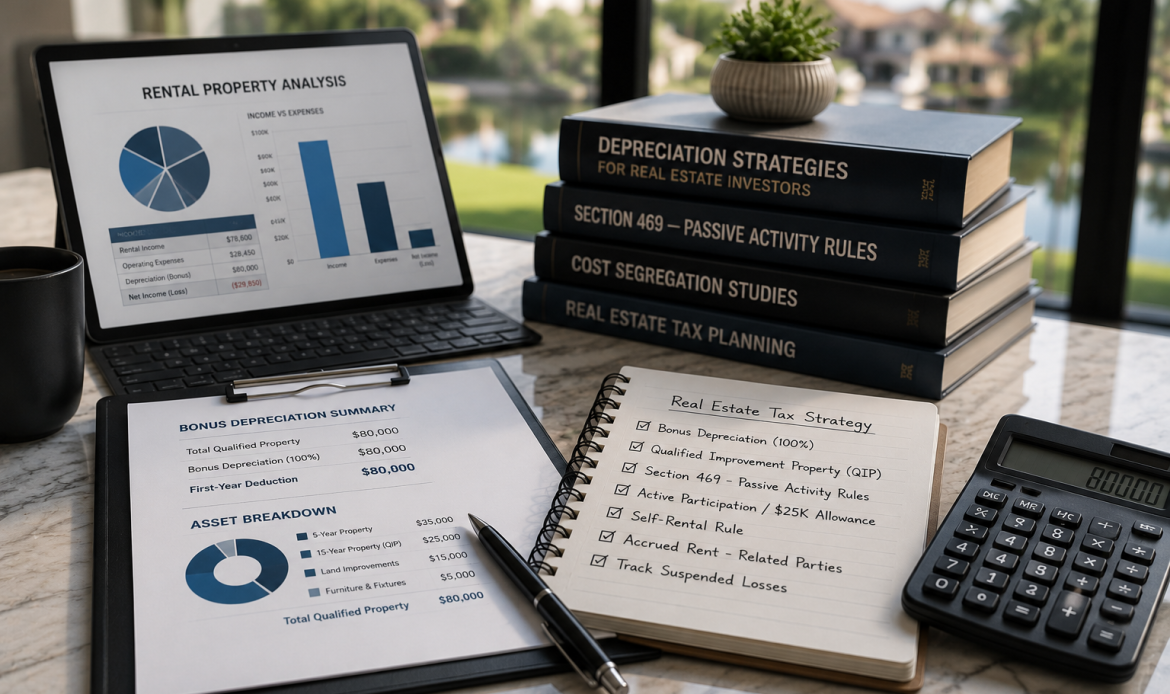
Bonus depreciation asks how much of a property’s cost can be deducted this year. Section 469 asks whether that deduction can offset other income this year. A landlord may spend $80,000 on qualifying property and claim an $80,000 bonus deduction, yet if the rental is passive and the owner has no passive income, some or all of the loss may be suspended.
A large deduction does not always create a current reduction in tax. Before accelerating depreciation, landlords should weigh their income, participation level, passive income, suspended losses, and sale plans. A trusted CPA firm in Billings, MT can help review depreciation schedules, passive losses, participation records, and future sale effects.
What 100% Bonus Depreciation Means for Landlords
Bonus depreciation is an additional first-year deduction under Section 168(k), currently 100% for qualifying property acquired after January 19, 2025, once placed in service — ready and available for rental use.
Both new and qualifying used property may be eligible, though used property must meet acquisition rules (for example, it generally can’t have been previously used by the same taxpayer or bought from a related party).
Bonus depreciation isn’t mandatory. A taxpayer can elect out for a class of property — useful when the full deduction would create a passive loss that can’t currently be used.
The Rental Building Itself Doesn’t Get a 100% Write-Off
Residential rental buildings are generally depreciated over 27.5 years; nonresidential real property over 39 years. Land isn’t depreciable. Bonus depreciation generally applies only to eligible property with a 20-year-or-shorter recovery period:
| Property or cost | Possible tax treatment |
| Residential rental building | 27.5 years |
| Commercial building | 39 years |
| Land | Not depreciable |
| Furniture, appliances, carpeting | May qualify for shorter life and bonus treatment |
| Fencing, landscaping, parking, sidewalks | May qualify as land improvements |
| Qualified Improvement Property | 15 years; bonus-eligible |
| Building structure and core systems | Usually remain long-life real property |
The exact classification depends on the asset, its use, and how the cost was documented — a generic list shouldn’t replace an asset-level review.
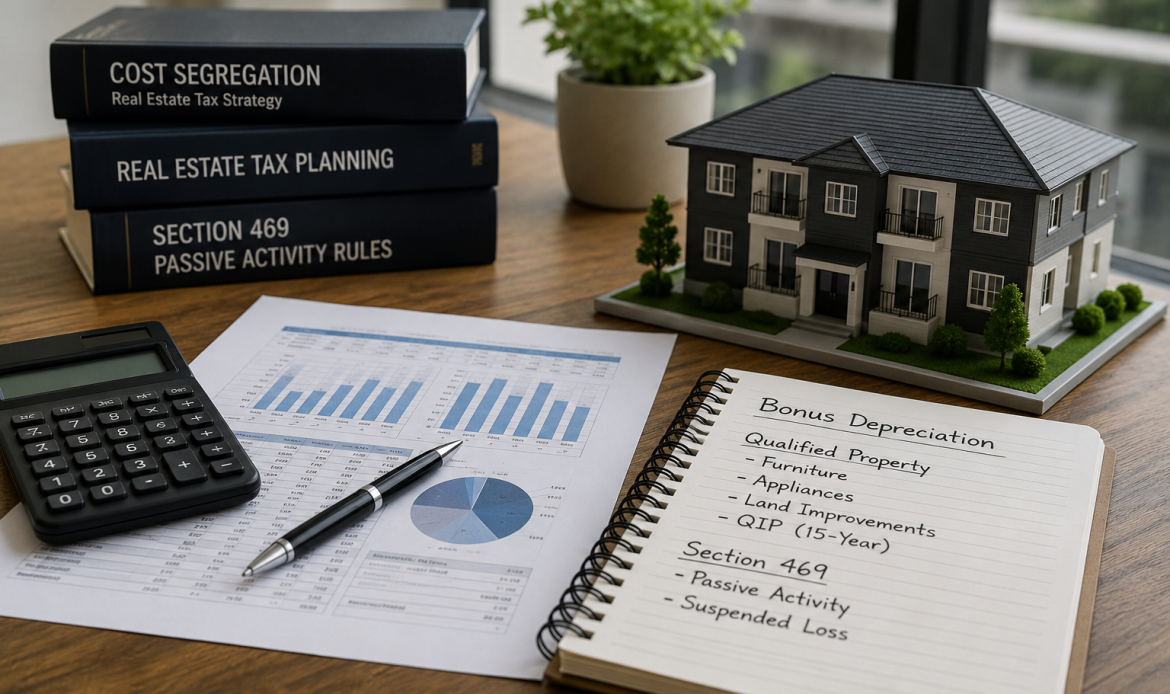
How Cost Segregation Increases the First-Year Deduction
A cost segregation study separates a building’s cost into different asset groups instead of treating nearly all of it as one 27.5-year or 39-year asset, identifying 5-year, 7-year, or 15-year property — including QIP — eligible for bonus depreciation.
Example: A landlord buys a rental for $700,000, with $100,000 allocated to land, leaving a $600,000 depreciable basis. A study finds $75,000 of 5-year property and $45,000 of 15-year land improvements, leaving $480,000 as 27.5-year building. If bonus-eligible, the landlord may claim a $120,000 first-year deduction — but that doesn’t mean the full amount reduces salary income; Section 469 still applies.
Qualified Improvement Property (QIP)
Qualified Improvement Property, or QIP, is an improvement made by the taxpayer to the interior of a nonresidential building after the building was first placed in service. It’s a frequent finding in cost segregation studies for commercial, retail, and mixed-use properties, and it’s treated separately from the personal property and land improvements discussed above.
QIP generally excludes:
- Enlargement of the building
- Elevators and escalators
- Changes to the building’s internal structural framework
Why it matters: QIP has a 15-year recovery period, making it eligible for 100% bonus depreciation — unlike the building shell, which stays on a 39-year schedule. A landlord finishing out interior office or retail space may expense most of that cost immediately rather than over decades.
QIP generally doesn’t apply to residential rental buildings the same way, since those improvements typically follow the regular residential rules. Like other bonus-eligible property, QIP still flows into the Section 469 analysis — a large QIP deduction can create a suspended loss just like any other bonus claim.
How Section 469 Treats Your Rental Losses as Passive
Section 469 generally limits losses from passive activities. Rental activities are usually treated as passive unless a specific exception applies.
A passive activity generally includes a business in which the taxpayer does not materially participate. However, rental activities are generally treated as passive even when the owner makes management decisions, approves tenants, collects rent, or arranges repairs.
Passive losses can generally offset passive income. They normally cannot offset wages, interest, dividends, or income from a business in which the taxpayer materially participates. An unusable loss becomes a suspended passive loss and generally carries forward to a later year.
The $25,000 Rental Real Estate Loss Allowance
A landlord who actively participates — a lower bar than material participation — may use up to $25,000 of passive rental loss against nonpassive income. The allowance phases out by 50 cents per dollar of modified adjusted gross income above $100,000, reaching zero at $150,000.
Real estate professional status alone doesn’t make a loss nonpassive — the owner must also materially participate in that specific activity.
What Counts as Material Participation?
IRS Publication 925 explains the material participation tests, real estate professional requirements, active participation allowance, self-rental rules, and passive activity limits. IRS Publication 925 lists seven tests, commonly including:
- Participating more than 500 hours during the year
- Performing substantially all the activity’s participation
- More than 100 hours, and at least as much as anyone else
- Regular, continuous, and substantial participation under the facts-and-circumstances test
Investor-level work — reviewing reports, monitoring finances — often doesn’t count if the owner isn’t directly involved in daily operations. Time spent by property managers can affect whether a test is met, so owners should keep timely, detailed records of dates, hours, and work performed.
A real estate professional with several properties generally must test material participation separately for each, unless a valid election treats all rental interests as one activity — a choice with long-term consequences.
Some short-term rentals fall outside the rental definition entirely (average stay of seven days or less, or 30 days or less with significant personal services), in which case material participation — not real estate professional status — determines the tax treatment.

Rent and Passive Activity Interactions
Two rent-related issues often complicate the §469 analysis.
Self-rental recharacterization. If a landlord rents property to a business they materially participate in, net rental income from that arrangement is recharacterized as nonpassive — it can’t be offset by passive losses elsewhere. A net rental loss from the same arrangement still stays passive. This trips up owners who lease a building to their own operating company, expecting the rental income to absorb other losses.
Related-party accrued rent. A timing issue can arise when an accrual-method operating business owes rent to a related cash-method landlord. Under IRC Section 267, the business may not be able to deduct the accrued but unpaid rent until the landlord includes the payment in income.
Both issues are easy to miss when a rental involves a related business or related-party lease terms, and both should be reviewed before finalizing depreciation and passive loss positions.
How Bonus Depreciation and Section 469 Work Together
Consider a landlord who buys an apartment property and completes a cost segregation study producing a $150,000 bonus deduction. The rental has $40,000 of income before depreciation, so after the deduction it shows a $110,000 tax loss. The landlord has no passive income, isn’t a real estate professional, and has income above $150,000.
The likely result: the deduction reduces rental income, the activity produces a $110,000 passive loss, Section 469 suspends it, and it carries forward. The deduction still has value — the benefit is just delayed, which can disappoint an owner expecting an immediate reduction against salary.
A Later Sale Can Create Another Tax Issue
Depreciation reduces basis, and a lower basis increases taxable gain on sale. Accelerated depreciation may also trigger recapture, depending on whether the asset is personal property, a land improvement, QIP, or part of the building. Suspended losses may be released on a fully taxable sale of the entire activity to an unrelated buyer, but the released loss and the sale gain need to be reviewed together — a strategy shouldn’t be judged on the first-year deduction alone.
Records Landlords Should Keep
Purchase documents; land/building allocations; cost segregation reports; placed-in-service dates and depreciation schedules; lease and management agreements; activity logs describing actual work performed; related-party lease and payment records and keep prior-year suspended loss schedules, Form 4562, Schedule E records, and Form 8582. A calendar created at tax time is far less convincing than records kept throughout the year.
Common Landlord Tax Mistakes
- Applying bonus depreciation to the full building, or misclassifying QIP as building shell
- Including land in the depreciable basis
- Using unsupported cost segregation estimates
- Confusing active participation with material participation
- Assuming real estate professional status alone makes losses deductible
- Counting investor-level research as participation
- Overlooking self-rental recharacterization on related-business leases
- Missing the §267 related-party accrued rent timing rule
- Forgetting the passive loss income phaseout or losing track of suspended losses
- Ignoring depreciation recapture on sale
Rental Property Tax Planning in Billings, Montana
Mason CPA, P.C. offers tax and accounting services for real estate in Billings, MT, including property-level income and expense tracking, depreciation and QIP planning, rental accounting, and support for property sales. Derrek Mason, CPA, is listed by the Montana Society of CPAs under certification number 033057.
Landlords seeking tax and accounting services for real estate in Billings, MT should review bonus depreciation, QIP, and Section 469 together, and keep participation records current throughout the year. Mason CPA, P.C. can help with depreciation schedules, passive losses, self-rental and related-party rent issues, and future sale planning.
Related Montana Tax Guide
Property owners who also operate farms or ranches can review our guide, Sold Extra Cattle Because of Drought? How to Reduce the Tax Hit.
Call (406) 792-1982 or email derrek@masoncpapc.com to discuss rental property depreciation and passive loss planning before filing.
Frequently Asked Questions
Does 100% bonus depreciation apply to a rental building? No. Residential buildings depreciate over 27.5 years and commercial buildings over 39 years. Bonus depreciation may apply to qualifying furniture, appliances, land improvements, and QIP separated from the building.
What is Qualified Improvement Property? QIP is an interior improvement to a nonresidential building made after the building was first placed in service. It generally has a 15-year recovery period and is eligible for 100% bonus depreciation, unlike the building shell itself.
Can bonus depreciation create a rental loss? Yes. A large deduction can push rental expenses above rental income, but Section 469 may classify and suspend that loss if the landlord lacks passive income or another exception.
Can a landlord use rental losses against W-2 income? Sometimes. An actively participating landlord may qualify for up to $25,000, subject to income phaseouts between $100,000 and $150,000 of modified adjusted gross income. A materially participating real estate professional may also treat losses as nonpassive.
What happens if I rent property to my own business? Net rental income from property rented to a business you materially participate in is recharacterized as nonpassive under the self-rental rule, so it can’t be offset by passive losses elsewhere. A net loss from that same arrangement stays passive.
Does accrued rent between related parties create a deduction problem? Yes. Under §267, an accrual-basis landlord generally can’t deduct rent accrued but unpaid to a related cash-basis party until that party reports it as income, which can shift the deduction — and the passive loss calculation — into a later year.
Can a Billings landlord deduct suspended passive losses later? Yes. Suspended losses generally carry forward and may offset future passive income or become available after a qualifying sale of the entire activity.